Egyptian and Bohemian band
The Hunchback of Notre DameThe Egyptian and Bohemian band is a traveling community that enters the story through public spectacle, remembered encounters, and accusations that reveal as much about the fears of settled society as about the group itself. The narrative gives the band a visible social presence, including leaders, families, and protective ties to Esmeralda, while repeatedly showing how outsiders cast its members as foreign, suspect, and threatening. Its role is therefore double: it belongs to the story’s world as a community, but also to the machinery of rumor and exclusion that shapes how other characters interpret it.
Identity and Representation
The account describes the band through several overlapping labels, including Egyptians, Bohemians, and gypsies. These are the names used by the characters and narration, not a neutral or consistent account of the group’s identity. In Mahiette’s recollection, the travelers arrive in a town under a duke and counts; she describes their clothing and appearance, their children, and their encampment beyond the gate. Her language turns difference into spectacle, presenting the group through the settled townspeople’s gaze. The distinction matters: her story records what she remembers and what people believed, rather than offering an independent verification of every claim she repeats.
The band is not represented only as an undifferentiated crowd. In Paris, its procession has a hierarchy, with the Duke of Egypt at its head, mounted while counts walk beside him. Men, women, and children follow, and the account emphasizes that the whole contingent is dressed in worn clothing. The scene makes leadership and family life visible within a display that is also deliberately theatrical. The procession is part of a larger public gathering: it reaches the Place de Grève amid torches and noise, after attracting additional participants along the way. The group thus appears both as a community moving through the city and as one element in a carnivalesque public spectacle.
Customs, Stories, and Suspicion
Mahiette recounts that the travelers she remembers claimed a religiously prescribed period of wandering and were said to possess authorization to collect money from church officials. She also describes their fortune-telling and the crowds drawn to it. These details establish the stories circulating around the group, but the account entwines reported customs with hostile allegations: theft, the taking of children, and the consumption of human flesh. The townspeople’s conduct is tellingly divided. They warn one another away and then go secretly to consult the fortune-tellers themselves, attracted by the very marvels they publicly distrust.
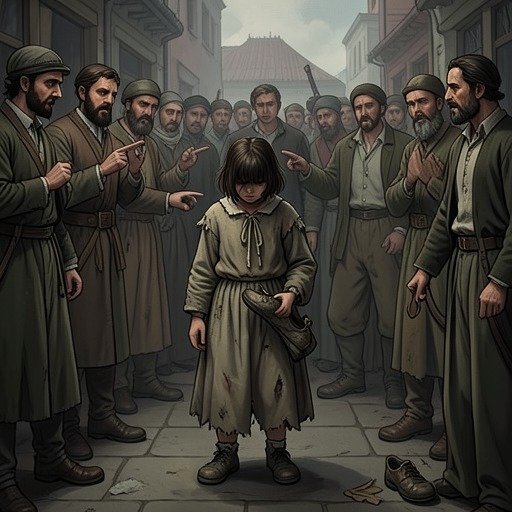
That mixture of fascination and suspicion intensifies in the story of Paquette la Chantefleurie and her daughter Agnes. Mahiette says Paquette brought her infant to the travelers to hear predictions about the child’s future; the women admired and kissed Agnes, especially praising her feet and shoes. After Paquette left the child briefly alone, a neighbor reported seeing two members of the band enter with a bundle and leave after closing the door. Paquette returned to find a different, deformed infant in the room, while her own child was gone. The reported visit and the substitution are the concrete circumstances of Mahiette’s account; they do not establish the more lurid explanation that the missing child was killed or eaten.
The rumors acquire a false air of confirmation when evidence of a fire, ribbons belonging to Agnes, blood, and a ram’s remains is found outside the town. Mahiette recounts how observers interpreted these traces through religious and ethnic prejudice, taking them as proof of a forbidden rite and the child’s death. Paquette’s grief and the disappearance of the travelers are real within the story as she tells it; the supernatural and cannibalistic conclusions are accusations, not verified facts. By keeping those categories distinct, the episode shows how an unexplained loss can be converted into a confident collective indictment.
Esmeralda and the Band’s Protection
The band’s relationship with Esmeralda is presented through Pierre Gringoire’s account of her life and standing among its members. He says that the Duke of Egypt has taken her under his protection and that the wider group holds her in unusual veneration. He describes her as having traveled from childhood with the wandering company through several regions before arriving in France while still young. In his telling, that mobile upbringing accounts for her mixed vocabulary, songs, and ideas, as well as for the lively manner that attracts audiences in the neighborhoods she visits. His account is itself limited and occasionally fanciful, but it establishes that Esmeralda is not simply an isolated performer: she has ties to a community that shelters and esteems her.
Those ties are also evident in the band’s place in public performance. When Pierre Gringoire first sees Esmeralda dancing, the watching crowd is absorbed by her movement and appearance; she is accompanied by a tambourine and dances on an old rug. The scene presents her as a performer whose art commands attention, even as the description approaches the language of the supernatural. Later, the band’s procession displays its members collectively to the same urban public. The contrast is sharp: individual performance can win admiration, while collective visibility invites suspicion and caricature.
Prejudice and Narrative Significance
The recluse at the Rat-Hole gives the story’s inherited accusation a personal and recurring voice. Seeing the scene at the pillory, she recognizes Esmeralda as the supposed child-stealer and curses her as a daughter of Egypt. Her response joins the earlier loss of Agnes to the present persecution of the dancer, although the accusation rests on the recluse’s conviction rather than on proof that Esmeralda took the child. The two scenes meet at the moment of her outcry, exposing how a private bereavement has become a public explanation for hostility toward the band and its perceived members.
The portrayal does not erase the group’s agency: it gives the band leaders, families, movement, customs, and a protective relationship with Esmeralda. But much of what the city claims to know about it arrives through frightened recollection, gossip, and interpretation of ambiguous signs. Even Pierre Gringoire’s explanation of Esmeralda’s safeguards combines genuine social bonds with speculation about the Duke’s purposes. The band consequently occupies an unstable position in the narrative: visible enough to organize and protect its members, yet repeatedly made into an object of other people’s fascination and fear. Its scenes expose the ease with which spectacle becomes suspicion and suspicion, in turn, supplies a rationale for exclusion.